1
/
of
1
VetMedMath Tutoring
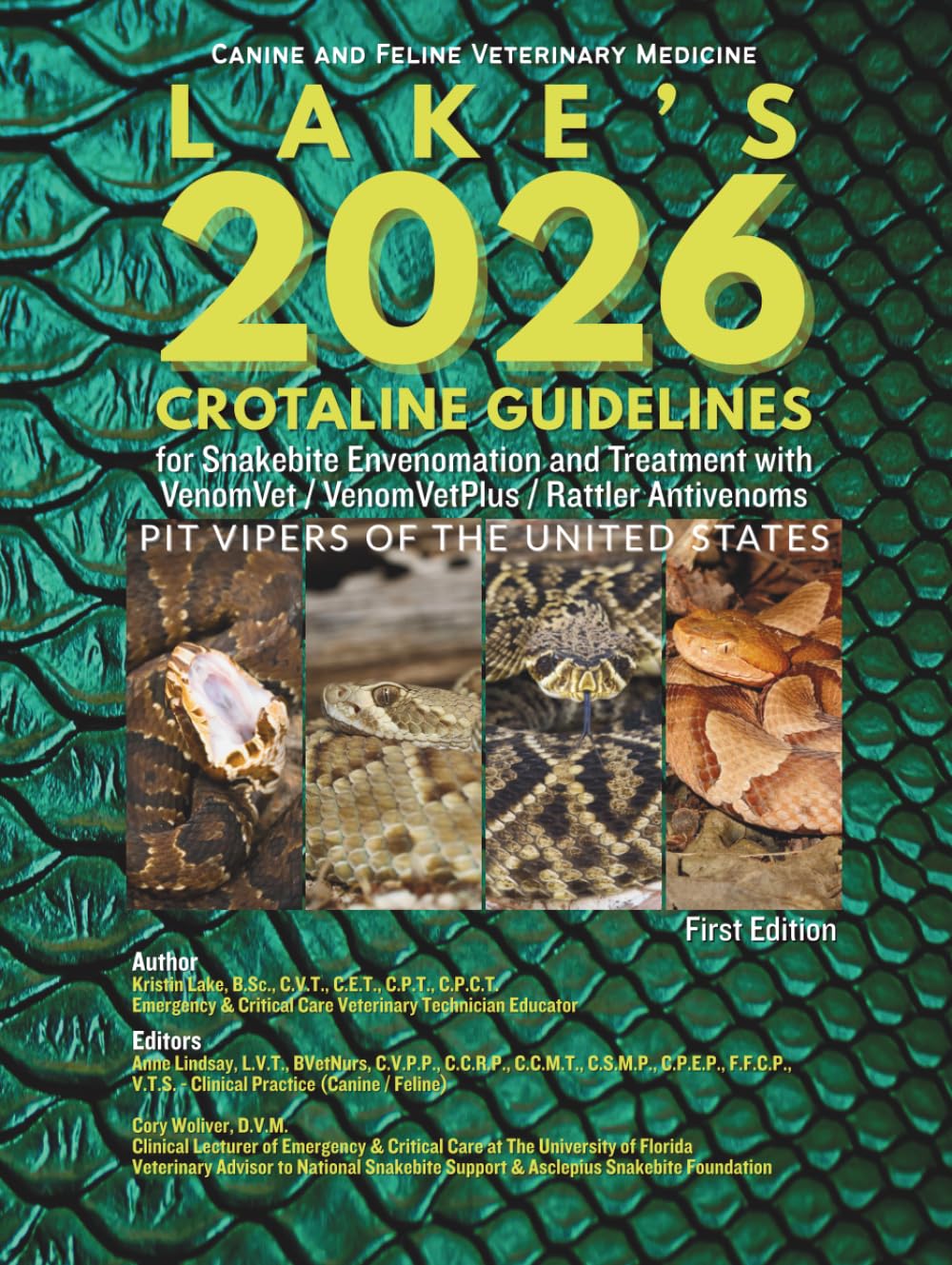
HARDCOVER - Lake's 2026 Crotaline Guidelines for Snakebite Envenomation and Treatment with VenomVet / VenomVetPlus / Rattler Antivenoms: Canine and Feline Emergency and Critical Care Veterinary Medicine
HARDCOVER - Lake's 2026 Crotaline Guidelines for Snakebite Envenomation and Treatment with VenomVet / VenomVetPlus / Rattler Antivenoms: Canine and Feline Emergency and Critical Care Veterinary Medicine
Regular price
$134.99 USD
Regular price
Sale price
$134.99 USD
Unit price
/
per
Shipping calculated at checkout.
Couldn't load pickup availability
Please select Buy on Amazon button
Look Inside the Book:
https://read.amazon.com/sample/B0GQPXW8L3?clientId=share
Leave An Amazon Review Here:
https://www.amazon.com/review/create-review/ref=cm_cr_othr_d_wr_but_top?ie=UTF8&channel=glance-detail&asin=B0GQPXW8L3
ABOUT THE BOOK
‘Lake’s 2026 Crotaline Guidelines for Snakebite Envenomation and Treatment with VenomVet / VenomVetPlus / Rattler Antivenoms’ is an evidence-based technical manual designed for Veterinarians and Credentialed Veterinary Technicians. This guide provides a comprehensive, step-by-step roadmap for the emergency management of Crotaline (pit viper) envenomations in dogs and cats in the United States.
Key Features and Topic Coverage:
* Emergency Protocols: Detailed procedures for triaging and stabilizing both unstable patients (requiring interventions like RECOVER CPR) and stable patients.
* Targeted Identification: Guidance on identifying major U.S. pit vipers, including Copperheads, Cottonmouths, and various Rattlesnakes (Mojave, Timber, Canebrake, Eastern & Western Diamondbacks, Northern & Southern Pacific, Pygmy and Prairie), and tables describing specific venom components and clinical considerations for each species of snake.
* Diagnostics: Instructions for immediate laboratory analysis, including blood smears to detect echinocytosis and spherocytosis, and thrombocytopenia, as well as complete blood count, serum biochemistry, coagulation testing, venous blood gas analysis, lactate, blood glucose, creatine kinase, ionized calcium, and full urinalysis testing.
* Contemporary Treatment: Specific administration protocols for VenomVet, VenomVetPlus, and Rattler antivenoms according to severity of envenomation, alongside multiple strategies for pain management utilizing full-mu opioids.
* Medical Math: Throughout the book there are essential calculations for fluid boluses, vasopressors and pain management Constant Rate Infusions, fluid additives, and antivenom dosages.
Written by Kristin Lake, B.Sc., C.V.T., C.E.T., C.P.T., C.P.C.T., who has 23 years of experience in Veterinary Medicine, and is an Emergency and Critical Care Veterinary Technician Educator.
This book aims to dispel common misconceptions and contraindicated techniques that can cause harm during snakebite cases, while giving the most up-to-date guidelines in Crotaline snakebite envenomation diagnosis and treatment for dogs and cats.
It emphasizes a "team-based" approach to care, ensuring that every member of the Veterinary staff is equipped with gold-standard treatment guidelines.
Identifying the Threat: The Snake Identification Chart with Photos
In ‘Lake’s 2026 Crotaline Guidelines for Snakebite Envenomation & Treatment with VenomVet / VenomVetPlus / Rattler Antivenoms’, we have included a comprehensive Snake Identification Chart with High-Resolution Photos specifically designed for the clinical environment. This isn’t just a reference for the vet; it’s a powerful communication tool for the exam room.
Why This Matters for Your Practice:
• Visual Confirmation: Instead of relying on vague descriptions like “it was brownish,” Veterinarians can present clear, professional imagery to the pet owner. This visual aid helps narrow down the species—whether it’s a Copperhead, Cottonmouth, or a specific Rattlesnake—ensuring the treatment plan aligns with the likely venom profile.
• Precision in Treatment: Accurate identification supports the targeted use of VenomVet, VenomVetPlus and Rattler antivenoms. By confirming the snake species, you can better anticipate clinical progression and dosing needs.
• Streamlined Triage: In an emergency, every second counts. Having a curated, localized chart at your fingertips eliminates the need for “Dr. Google” searches, which are often fraught with misinformation and non-regional species.
This chart transforms a chaotic “he-said-she-said” scenario into a clinical diagnostic step, ensuring your feline and canine patients receive the precise care they need.
Edited By: Anne Lindsay, L.V.T, BVetNurs, C.V.P.P., C.C.R.P., C.C.M.T., C.S.M.P., C.P.E.P., F.F.C.P., V.T.S. Clinical Practice (Canine/Feline)
Edited By: Cory Woliver, D.V.M.
Share